


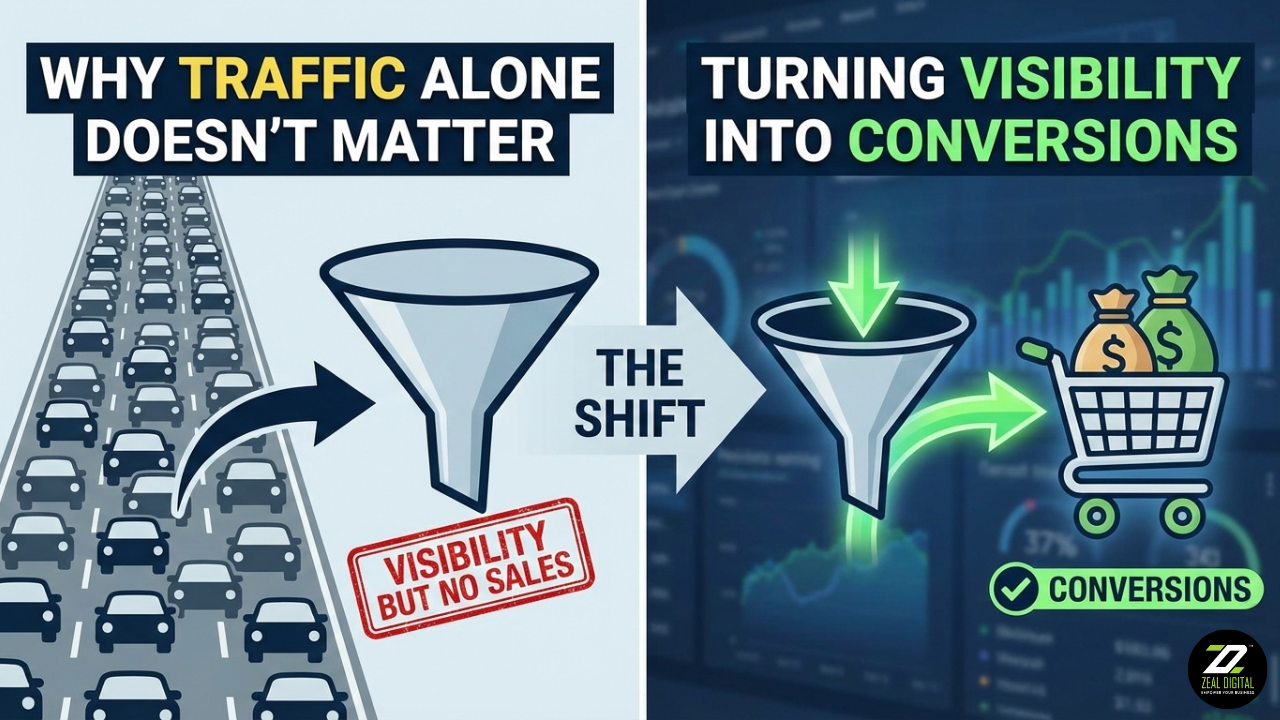
For years, businesses have been taught that more website traffic equals success. Higher visitor numbers were seen as proof that marketing efforts were working and that growth was inevitable. However, in today’s digital landscape, traffic alone is no longer a reliable measure of performance. What truly matters is not how many people visit your website, but what they do once they arrive.
In an era shaped by AI-driven search, personalised results and increasingly informed users, visibility without conversions often signals deeper strategic issues. Australian businesses must now focus on turning attention into action if they want digital marketing to deliver real commercial value.
The Illusion of High Traffic
Website traffic can be misleading. A spike in visitors may look impressive in analytics reports, but it does not automatically translate into leads, sales or enquiries.
Why Traffic Numbers Can Be Deceptive
High traffic with low conversions often indicates:
- Visitors are not the right audience
- Content does not match user intent
- The website experience creates friction
- Calls to action are unclear or weak
Without engagement or conversion, traffic becomes a vanity metric rather than a growth driver.
Understanding Visibility Versus Value
Visibility refers to how often your brand or website is seen. Value is created when that visibility results in meaningful action.
The Difference Between Being Seen and Being Chosen
A user may land on a page because it ranks well or appears in search results, but:
- If the message is unclear, they will leave
- If trust is not established, they will hesitate
- If the next step is confusing, they will abandon the journey
Conversions happen when visibility is supported by relevance, clarity and trust.
The Role of User Intent in Conversions
One of the most common reasons traffic fails to convert is a mismatch between content and intent.
Why Intent Matters
Users arrive at websites with different goals. Some are researching, some are comparing options, and others are ready to take action. If content does not align with the user’s stage of the journey, conversions are unlikely.
Common Intent Mismatches
- Informational content pushing aggressive sales
- Product pages targeting users who are still researching
- Generic messaging that fails to address specific needs
Understanding intent allows businesses to guide users naturally towards conversion rather than forcing outcomes.
Website Experience as a Conversion Driver
Even highly relevant traffic can fail to convert if the website experience is poor.
Key Experience Factors That Influence Conversions
A website must:
- Load quickly and function smoothly
- Be easy to navigate across all devices
- Present information clearly and logically
- Reduce friction at every step
Confusing layouts, slow performance and cluttered design all undermine trust and reduce the likelihood of action.
Trust Signals and Their Impact on Decision-Making
Modern users are cautious. Before converting, they look for reassurance that a business is credible and reliable.
What Builds Trust on a Website
Effective trust signals include:
- Clear contact details and business information
- Customer testimonials and reviews
- Case studies or proof of results
- Transparent pricing or service explanations
Without trust, even highly interested visitors are unlikely to convert.
Calls to Action That Actually Work
A call to action (CTA) bridges the gap between interest and conversion. Weak or unclear CTAs are a common reason traffic fails to deliver results.
Characteristics of Effective Calls to Action
Strong CTAs are:
- Clear about what will happen next
- Aligned with user intent
- Easy to find without being intrusive
- Supported by persuasive messaging
Instead of simply asking users to “contact us”, effective CTAs explain the value of taking that step.
Measuring What Truly Matters
Focusing solely on traffic numbers can distract businesses from more meaningful performance indicators.
Metrics That Reflect Real Success
More valuable metrics include:
- Conversion rates
- Lead quality
- Engagement depth
- Cost per acquisition
These indicators reveal whether visibility is translating into tangible outcomes rather than just attention.
Optimisation Is an Ongoing Process
Turning traffic into conversions is not a one-time fix. It requires continuous testing, refinement and improvement.
Areas That Benefit from Ongoing Optimisation
Businesses should regularly review:
- Content relevance and messaging
- Page layouts and navigation
- Forms and checkout processes
- CTAs and user journeys
Small improvements across these areas can have a significant cumulative impact on conversion performance.
Aligning SEO With Conversion Strategy
Search visibility should support business objectives, not exist in isolation.
Why SEO and Conversion Optimisation Must Work Together
SEO brings users to your site, but conversion optimisation turns those users into customers. When both strategies are aligned:
- Traffic quality improves
- User journeys become more coherent
- Marketing efforts deliver measurable ROI
Visibility without conversion is incomplete; the two must be developed together.
Conclusion
Traffic alone no longer defines digital success. In a competitive, AI-influenced search landscape, businesses must focus on attracting the right audience and guiding them towards meaningful action. By aligning content with intent, improving website experience, building trust and refining calls to action, visibility can be transformed into real results. For businesses targeting local growth, investing in strategic SEO and conversion-focused optimisation is essential — particularly when competing for high-value opportunities such as SEO in Parramatta.
Frequently Asked Questions
What causes traffic to fail to convert?
Common causes include mismatched user intent, poor website experience, weak trust signals and unclear calls to action.
How can I improve conversions without increasing traffic?
By optimising existing pages, improving messaging, simplifying navigation and strengthening CTAs.
What is the role of user intent in conversions?
User intent determines what type of content and action a visitor is ready for. Aligning content with intent increases the likelihood of conversion.
Do design and layout really affect conversions?
Yes. Poor design creates friction and confusion, while clear layouts build trust and guide users smoothly towards action.
Should SEO focus on traffic or conversions?
SEO should focus on attracting the right audience and supporting conversion goals, not just increasing visitor numbers.
How often should conversion optimisation be reviewed?
Regularly. User behaviour, expectations and technology change, making continuous optimisation essential for long-term success.