


Digital advertising has always relied on trust.
Trust that impressions are real.
Trust that clicks reflect genuine intent.
Trust that advertising budgets aren’t quietly drained by manipulation.
For years, advertisers accepted a certain level of inefficiency as unavoidable. Fraud existed in the background: sometimes visible, often undetected. But as competition intensified and budgets tightened, tolerance for waste diminished.
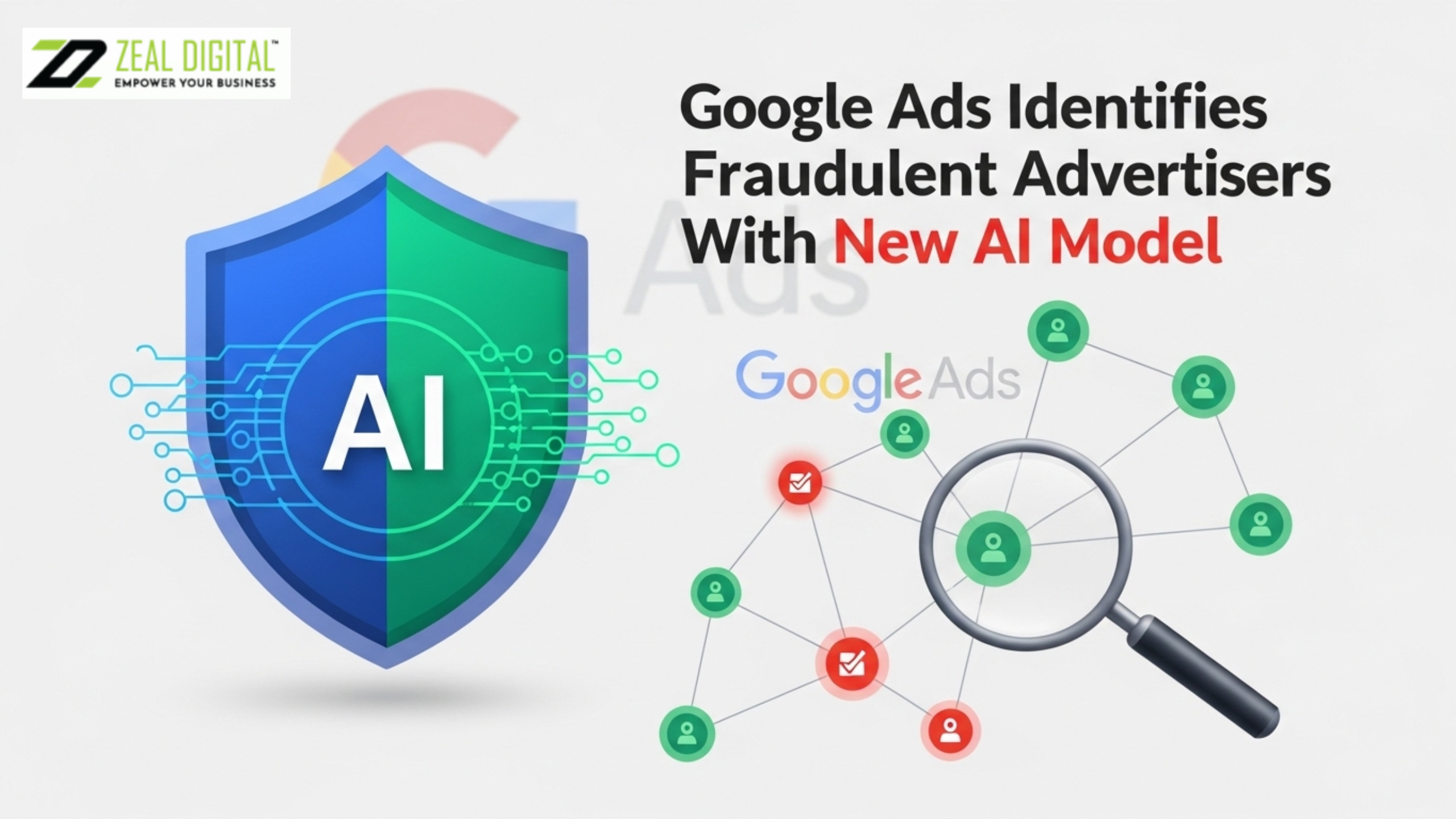
With the introduction of a new AI-powered model to identify fraudulent advertisers at scale, Google is taking a major step toward strengthening the integrity of its advertising ecosystem.
This isn’t just a technical update.
It represents a structural shift in how digital advertising is governed.
Why Fraud in Google Ads Has Been a Persistent Challenge
Online advertising has always attracted bad actors. These include:
- Fake business accounts
- Click farms
- Lead generation scams
- Impersonation schemes
- Malicious redirect networks
- Account recycling operations
Fraudulent advertisers exploit scale and complexity. They mimic legitimate behaviour, adapt quickly and operate across multiple accounts or platforms to avoid detection.
For genuine advertisers, the impact is significant:
- Artificially-inflated auction costs
- Diluted budgets
- Distorted performance data
- Reduced traffic quality
- Brand safety risks
At scale, these issues affect not just individual campaigns but overall market fairness.
From Rule-Based Detection to AI-Driven Intelligence
Historically, fraud detection relied on rule-based systems like:
- Suspicious IP tracking
- Abnormal click patterns
- Known blacklists
- Spending anomalies
While effective to a degree, these systems were reactive. They depended on identifying patterns that had already occurred.
Modern fraud doesn’t operate predictably. It evolves.
Google’s new AI model shifts detection from static rules to behavioural intelligence. Instead of simply looking for known violations, the system analyses patterns across vast datasets to understand what legitimate advertiser behaviour looks like, and flags deviations in real time.
This allows Google to identify:
- Coordinated fraud networks
- Synthetic business entities
- Identity masking
- Multi-account manipulation
- Cross-platform abuse
The focus moves from isolated violations to systemic fraud detection.
What Makes This AI Model Different?
Unlike traditional filters, this model functions as a foundational intelligence layer. It evaluates signals across:
- Account structures
- Payment history
- Ad copy consistency
- Landing page behaviour
- Historical activity
- Network relationships
Rather than analysing signals in isolation, it evaluates relationships between them. That ecosystem-level analysis makes it far more capable of identifying complex manipulation. In practical terms, it means fraudulent advertisers are detected earlier, often before they can scale.
Why This Matters for Legitimate Businesses
For compliant advertisers, stronger fraud detection is protective, not restrictive. When fraudulent accounts are removed:
- Auction competition becomes more genuine
- Cost inflation stabilises
- Traffic quality improves
- Data becomes more reliable
- ROI becomes more predictable
Over time, this creates a healthier marketplace where performance is driven by relevance and value rather than manipulation.
Businesses working with the best search engine marketing company often benefit faster, as their campaigns are already structured to align with platform policies and long-term account health principles.
A New Era of Advertiser Accountability
Improved detection also means increased scrutiny. Google’s systems are increasingly evaluating advertisers holistically, including:
- Business legitimacy
- Brand consistency
- Transparency
- User experience quality
- Compliance history
This signals a broader shift: compliance is no longer about avoiding obvious violations. It’s about demonstrating authenticity and operational credibility.
Short-term loopholes and aggressive grey-area tactics are becoming riskier. Sustainable growth now requires alignment with platform standards.
The Strategic Impact on Campaign Management
Stronger AI enforcement changes how campaigns must be managed. Advertisers must prioritise:
- Transparent messaging
- Accurate business representation
- High-quality landing pages
- Ethical data collection
- Long-term account stability
Quick-win tactics that compromise compliance can now lead to account restrictions or long-term trust erosion.
This makes strategic oversight essential; not just for performance optimisation, but for risk management.
The Competitive Advantage of Professional Management
As Google’s ecosystem becomes more regulated and intelligence-driven, campaign management is no longer purely tactical.
It requires:
- Ongoing policy monitoring
- Compliance auditing
- Account structure optimisation
- Risk assessment
- Platform trend interpretation
This is where partnering with the best search engine marketing company becomes strategic rather than optional.
Experienced agencies do more than run ads. They:
- Safeguard account integrity
- Anticipate enforcement changes
- Align campaigns with platform governance
- Protect long-term viability
In an AI-regulated environment, trust becomes a performance asset.
Trust as a Measurable Performance Driver
There is a growing connection between account trust and advertising outcomes.
Trusted advertisers typically experience:
- Greater account stability
- Faster approvals
- Lower suspension risk
- More predictable campaign delivery
- Stronger platform credibility
Over time, these advantages compound. Trust becomes an invisible yet powerful competitive differentiator.
Google’s AI-based fraud detection accelerates this shift by systematically rewarding authentic advertisers and filtering out manipulation.
What This Means for the Future of Search Advertising
Google’s investment in AI-driven fraud detection reflects a broader industry trend. Digital advertising is moving toward:
- Greater accountability
- Algorithmic governance
- Platform integrity enforcement
- Institutional maturity
Search advertising is no longer an open frontier. It increasingly resembles a regulated marketplace where credibility, transparency and compliance drive long-term success.
Final Perspective
Google’s new AI model for identifying fraudulent advertisers signals a clear direction for the future of paid search.
Integrity is becoming central to performance.
Compliance is becoming strategic.
Trust is becoming measurable.
For legitimate businesses, this is an opportunity, not a threat.
Those who compete on genuine value, maintain transparency and prioritise long-term account health will thrive in this new environment. And those supported by the best search engine marketing company will be best positioned to navigate the increasing complexity of AI-driven platform governance.
In the next era of search advertising, credibility will be the strongest competitive advantage of all.
Frequently Asked Questions (FAQs)
Will this AI system affect compliant advertisers?
Yes, but mostly in positive ways. Advertisers who follow platform policies and maintain transparent business practices are likely to benefit from improved account stability and reduced competition from fraudulent actors.
How can businesses protect their accounts under stricter enforcement?
Businesses should ensure that their ads, landing pages and business information are accurate and consistent. Regular compliance reviews and working with the best search engine marketing company can help minimise risk.
Can small businesses be affected by these changes?
Yes. AI-based enforcement applies to all advertisers, regardless of size. Small businesses must pay particular attention to policy compliance and user experience to avoid unintentional violations.
Does stronger fraud detection improve advertising performance?
Over time, yes. When fraudulent advertisers are removed, auction conditions improve, click quality increases, and budgets are used more efficiently, leading to better overall returns.
What role does an agency play in managing compliance risks?
A professional agency monitors policy updates, audits account structures and ensures campaigns align with platform standards. This reduces the likelihood of suspensions, restrictions or sudden performance declines.