


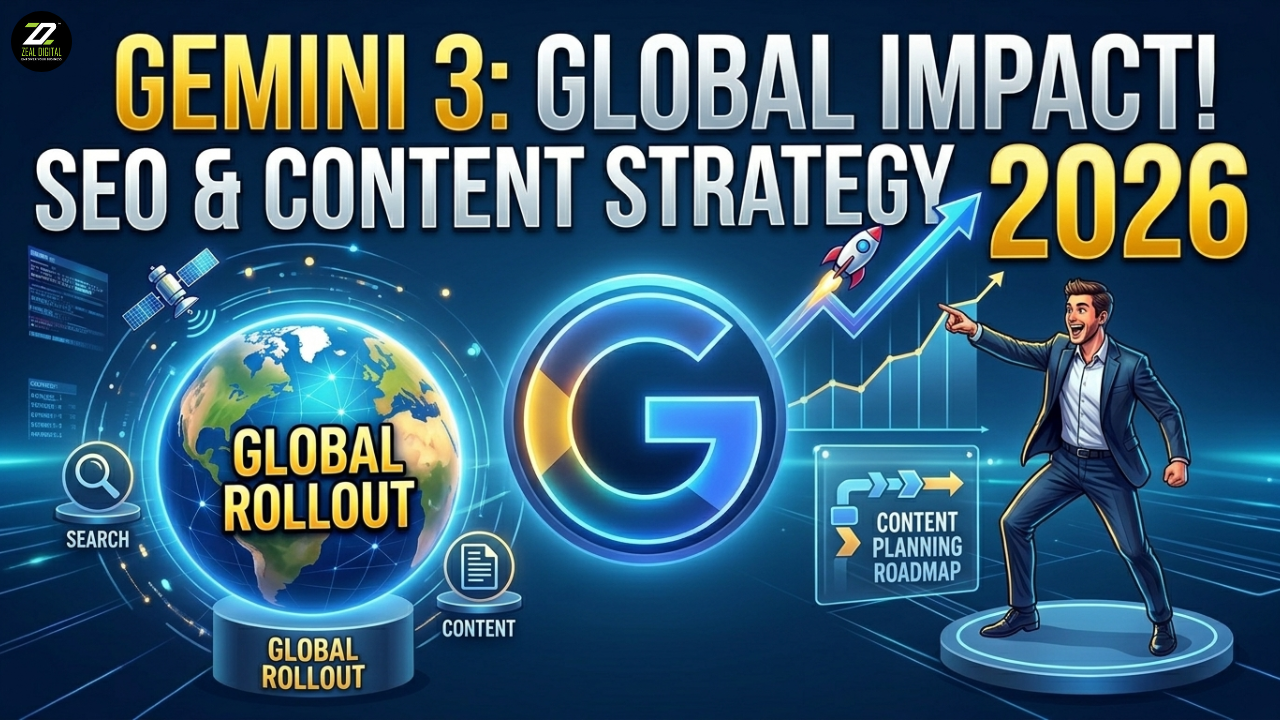
Something important is happening to search, and it is moving faster than most content strategies are keeping up with. Gemini 3’s global rollout is not a technology story in the abstract. For people working in SEO or content marketing, it is a practical shift in how the people you are trying to reach experience search results.
And the implications are more significant than most coverage has acknowledged.
What Gemini 3 Is Actually Doing in Search
Gemini 3 is Google’s most capable multimodal AI model to date. It handles text, images, audio, video, and code with substantially-improved reasoning ability compared to earlier versions. For the average person searching on Google, the most visible change is the quality and depth of AI Overviews.
These have become noticeably more conversational, more contextually accurate, and far more likely to answer a query so completely that clicking through to a website feels unnecessary.
That last part is the one worth sitting with.
The AI Overview Traffic Problem, Honestly Stated
AI Overviews were introduced to controversy. Early versions made errors. Cited sources poorly. Gave confident answers to questions they had no business answering confidently. Gemini 3 has greatly enhanced accuracy. Which is genuinely good for users.
The problem for publishers is that more accurate answers create more satisfying zero-click experiences. When someone searches how to do something and the AI Overview tells them, clearly and correctly, many of them never visit a website at all.
Traffic data from early 2026 is showing measurable drops in organic click-through rates for informational query types. How-to content. Definitions. Comparisons. Straightforward factual questions. These are the categories where AI Overviews are now most capable and most complete.
This does not make informational content pointless. It raises the bar for what makes it worth clicking.
What Content Still Gets Clicks
Not all query types are equally disrupted. There are content categories that continue to generate meaningful traffic even in a heavy AI Overview environment.
- Content with a genuine perspective. AI systems are increasingly capable, but they do not have credible opinions or original experiences. A piece of content grounded in a specific practitioner’s actual experience, proprietary data from your own research, or a strong editorial stance offers something an AI Overview simply cannot replicate. People click because they want the human behind the content.
- Content that requires trust. Health, legal, financial, and similar high-stakes topics benefit from users still wanting to verify with a credible human source. The instinct to check rather than accept an AI summary is strongest where the stakes of getting it wrong are highest.
- Very specific long-tail queries. Generalised AI Overviews struggle with niche, highly-specific questions. Deep content on narrow topics continues to attract qualified traffic that broad AI answers cannot fully serve.
- Interactive or tool-based content. Calculators, assessments, downloadable templates, and video demonstrations. None of these can be replicated in an AI Overview. They continue to pull meaningful engagement.
How Content Strategy Actually Needs to Change
The brands handling Gemini 3’s rollout well are not the ones producing more content. They are producing content that is inherently harder for an AI to replace.
Some practical shifts:
- Invest in original research. Survey findings, proprietary customer data, internal analysis. Content built on information that only you have cannot be sourced by an AI Overview because it does not exist anywhere else on the web.
- Build author authority properly. Bylined content from recognisable, credentialed experts sends EEAT signals that Google’s systems are genuinely designed to reward. Anonymous brand content does not benefit from this.
- Go deeper on complex topics. Multi-step problem-solving, nuanced decision support, and content that holds a reader’s hand through something genuinely difficult. This is where AI Overviews still fall short.
- Build topic clusters rather than isolated posts. Interlinking related content signals depth of coverage. It tells Google’s systems that your site is a genuine authority on a subject, not just a page that touched on a keyword once.
The Technical Side of This
Gemini 3’s multimodal capability changes image and video SEO from a secondary concern into a primary one. Google can now interpret and index visual content with significantly greater accuracy. Your images are being evaluated, not just your alt text.
Structured data matters more, not less, in this environment. Schema markup helps Google’s systems understand what your content is about and how it serves user intent. FAQ schema, HowTo schema, Article schema with author markup. These continue to influence how content is surfaced.
On Citations and Traffic Attribution
There is an ongoing frustration in the SEO community about this. When AI Overviews cite a source, the resulting traffic is inconsistent. Some publishers appear regularly in citations without seeing any corresponding analytics signal. Others see occasional referral spikes from AI placements.
The attribution model for AI-cited content is still messy. The honest response is to keep producing content that merits citation while not treating AI Overview placement as a reliable, trackable traffic channel yet.
Final Thoughts
Gemini 3’s rollout is not the end of SEO. But it is a meaningful evolutionary pressure on what gets rewarded. Depth, credibility, original perspective, and genuine expertise are now more important than volume and keyword targeting. Sites that build real authority, around real expertise, communicated by real people, are the ones that maintain visibility as AI-powered search continues to evolve. For businesses in competitive local markets, partnering with a credible SEO company in Parramatta to navigate this shift before your competitors do is no longer optional planning. It is urgent.
FAQs
Will AI Overviews replace traditional results entirely?
Not entirely. Complex, experience-based, and niche content still generates organic clicks. Simple queries are most affected.
Does structured data still matter?
More than ever. Schema markup helps AI systems interpret content correctly and increases eligibility for rich result appearances.
What content is most protected from AI Overview disruption?
Original research, strong editorial perspectives, practitioner experience, and deep content on specific niche topics.
Will Gemini 3 affect keyword rankings?
Indirectly yes. Click-through rates for certain queries are declining, making positions one through three more critical than before.