


Content strategy conversations usually reach this point eventually. Should we create things that stay useful for years, or chase current conversations and ride whatever traffic is moving through the moment? The answer most people give is both, which is accurate but not particularly useful without understanding the reasoning behind it.
So let us actually work through this properly instead of being fence-sitters.
What Each Type Is Actually Doing
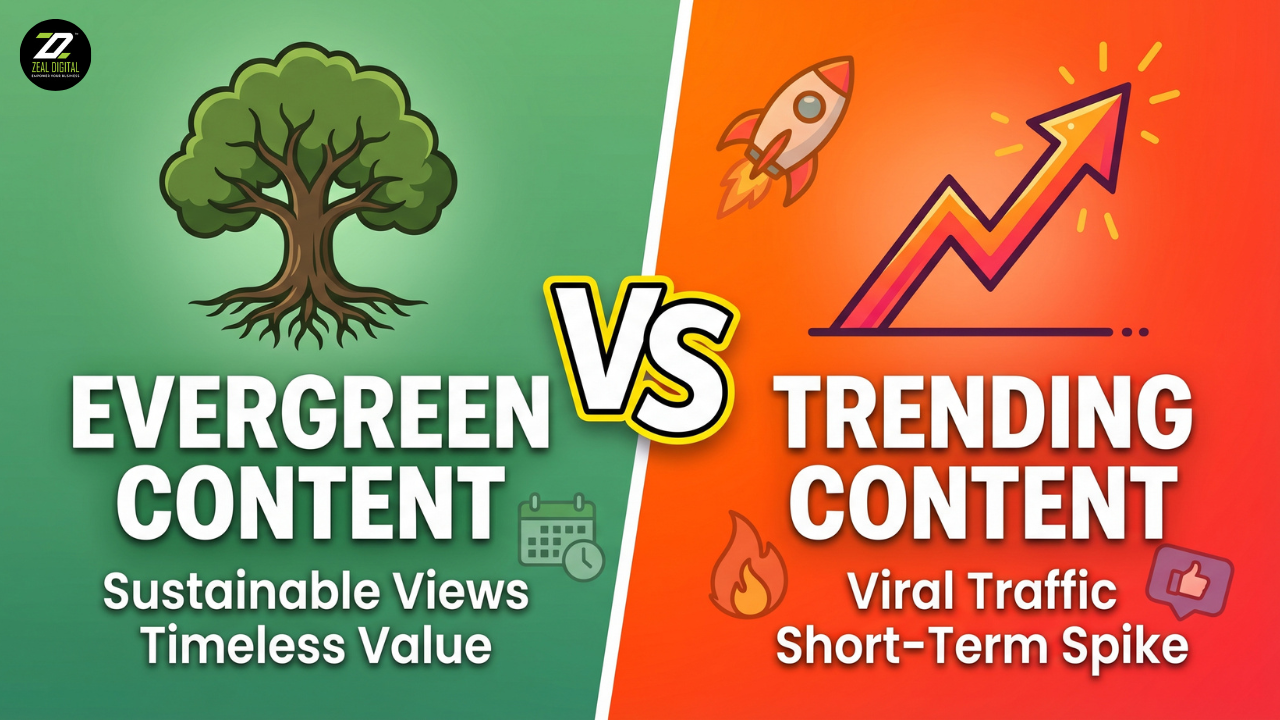
Evergreen content maintains its relevance regardless of when someone reads it. A guide on how to structure a client brief. An explanation of how keyword research works. A breakdown of what customer lifetime value means and why it matters. These are questions people ask consistently over time. The content does not spoil.
Trending content capitalises on a current moment. A response to a major platform update. A piece tied to a news event that is shaping how your industry thinks. Content built around a conversation that is happening right now. Traffic arrives in spikes.
Neither is inherently better. They serve different functions in a content programme, and understanding that distinction changes how you plan production.
The Compounding Case for Evergreen
The strongest argument for evergreen content is not just that it lasts. It is that it compounds.
A well-optimised piece built around stable search demand does not just generate traffic once. It generates traffic consistently, often for years, without additional production cost. Month one might be modest. Month 12 might be several hundred organic visits per month. Month 24 might be higher still, as authority accumulates and rankings solidify.
That trajectory is hard to achieve with any other content type. And the economics are compelling. You invest once in production, ongoing maintenance is periodic rather than constant, and the return continues long after the initial work is done.
- Stable search demand means the audience is always there
- Authority accumulates over time through earned links and user engagement signals
- Cost per acquisition from organic traffic drops as the asset matures
- The content works independently of your production schedule
The key caveat is maintenance. Evergreen content that sits untouched for three years is not evergreen anymore. Statistics become outdated. The tools mentioned may no longer exist. Industry context shifts. An annual review of key evergreen pieces keeps them genuinely current rather than just old.
The Legitimate Case for Trending
Trending content offers something that evergreen content structurally cannot. Immediacy.
When your audience is actively thinking about a topic right now, a well-considered piece entering that conversation at the right moment can generate significant traffic, social sharing, and inbound links from publications covering the same story. For building domain authority, that link acquisition has lasting value that extends well beyond the traffic spike itself.
Consistently showing up in trending conversations also signals something important about your brand. It demonstrates that your team is paying attention, has a point of view, and is willing to publish it quickly. That kind of visible relevance contributes to thought leadership in ways that are harder to build with evergreen content alone.
The shelf life is the trade-off. A post responding to a major industry event from 18 months ago may still attract residual long-tail traffic, but it will never approach its original performance. The investment-to-return ratio deteriorates over time.
Timing Makes or Breaks Trending Content
This is where most brands fail at trending content. They decide to cover a trend and publish two weeks after the conversation has peaked. The window is often measured in days. Sometimes hours. If you cannot produce and publish during the peak period, the opportunity is largely gone.
This is genuinely difficult for teams without an agile content process. Which is one honest reason why trending content represents a smaller proportion of most successful content programmes.
How the Two Work Together
The most effective content programmes treat evergreen and trending as complementary rather than competing investments.
Evergreen content forms the backbone of your organic search strategy. It attracts consistent traffic, builds topical authority across your content clusters, and compounds in value over time. It is the infrastructure.
Trending content creates spikes that can accelerate the long-game through specific mechanisms. A well-timed trending piece earns inbound links from industry publications, which pass authority to your evergreen content through internal linking. Social sharing of trending content increases branded search volume. Being visible in trending conversations keeps your content programme on the radar of journalists and influencers who may eventually become external linking sources.
A working allocation for most content programmes is roughly 70 to 80 per cent evergreen and 20 to 30 per cent trending. That ratio should flex based on how quickly your industry moves and how well-resourced your production process is.
Measuring Each Type Properly
Applying the wrong metrics to each content type produces misleading conclusions and poor decisions.
Evergreen content should be measured over long horizons. Organic traffic month-on-month over 12 months. Keyword ranking positions tracked over 6-12 months. Inbound links accumulated over time. Conversion rate from organic sessions. These are the signals that matter.
Trending content should be measured quickly. Traffic and social engagement in the first 7-14 days after publication. Backlinks generated in the immediate aftermath. Share of voice in the conversation during the peak period. Applying evergreen expectations to trending content makes it look like a failure when it is actually doing exactly what it should.
Final Thoughts
The either-or framing is a false choice. Evergreen content builds sustainable, compounding visibility that paid channels cannot match over time. Trending content builds momentum, authority signals, and cultural relevance in the short term. Both belong in a mature content programme. The question is how to allocate intelligently based on what your team can actually execute well. If you are working with or considering digital marketing services in Sydney, a capable content partner should be helping you build both components into a coherent strategy rather than defaulting to one approach because it is easier to sell.
FAQs
Should I update existing evergreen content or write new posts?
Updating high-performing existing content is usually more efficient than creating new posts covering the same territory.
What makes something truly evergreen?
Content addressing stable, ongoing questions in your industry rather than news-dependent or time-bound topics.
How quickly does trending content need to be published?
Ideally, within 24-72 hours of a trend peaking, to capture meaningful traffic during the window.
Can trending topics become evergreen over time?
Sometimes. Topics that generate lasting search interest can be updated and repositioned as evergreen resources.
How do I evaluate whether a trending topic is worth covering?
Check search volume data and honestly assess whether your team can add genuine expertise to the conversation quickly.
What is a realistic evergreen-to-trending content ratio?
Around 70 to 80 per cent evergreen and 20 to 30 per cent trending is a reasonable starting framework for most teams.