


Most marketing conversations eventually hit a wall. Someone wants to run ads. Someone else thinks the budget should go toward ranking organically. Both dig in. And the meeting ends without a real answer because, honestly, neither side is wrong.
But if the question is specifically about long-term return on investment, there is a more honest way to look at this. One that most agencies avoid because it complicates the pitch.
The Core Difference Nobody Explains Properly
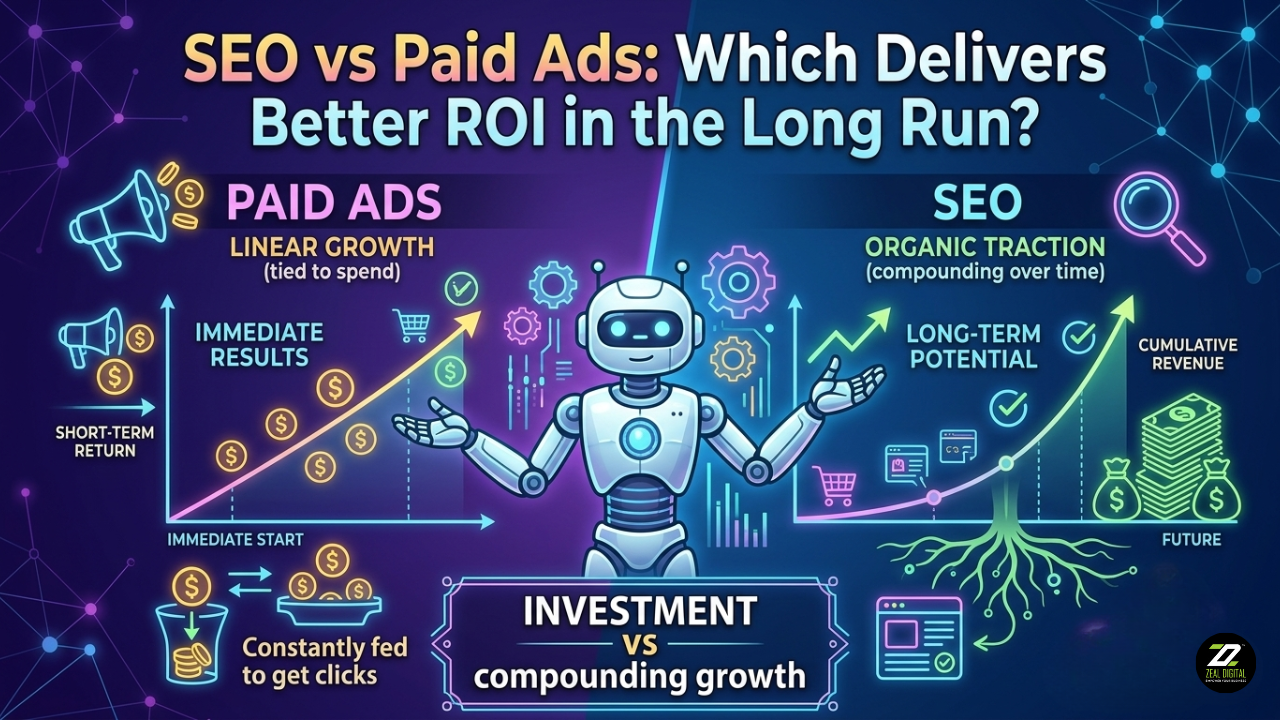
Paid advertising is a tap. Turn it on, traffic flows. Turn it off, it stops. Completely. Whatever you spent is spent, and the moment the budget dries up, the leads dry up with it.
Organic search is different. It builds something. A page that earns a position on the first page of Google keeps delivering clicks without additional spend. It is not instant. It is not always predictable. But it compounds.
That compounding quality is what makes the long-term ROI conversation interesting.
What Paid Ads Actually Cost You
There is a version of PPC that works brilliantly. Targeted, well-structured, tied to a strong landing page with a clear offer. When everything aligns, the cost per lead is manageable, and the returns are solid.
But that version requires constant management. And it requires money. Always.
Cost per click in competitive industries is brutal. Legal services, financial products, home renovation, and digital marketing itself. Some terms cost $40, $60, or $90 per click. Not per conversion. Per click. If your landing page converts at 3%, you are spending hundreds of dollars for a single lead.
That is not inherently wrong. But it means the economics only holds while the spending continues. There is no residual. No asset is being built.
The Hidden Waste
Most businesses running Google Ads are bleeding budget in places they cannot easily see. Broad match keywords trigger irrelevant searches. Poor Quality Scores drive up CPCs. Ad copy misaligned with the landing page experience. No negative keyword list to speak of.
An audit of almost any self-managed or neglected account will find this. And it adds up quickly.
The Slower, Stickier Case for Organic
Ask anyone who has been doing SEO long enough, and they will tell you the same thing. The first few months are frustrating. Traffic barely moves. Rankings inch forward.
Then something shifts.
A well-structured cluster of content, properly linked, hits a threshold of authority. Rankings improve. Traffic grows. And it keeps growing, often without significant new investment in that particular topic area. That page is now an asset on your site. It works while you sleep.
The compounding effect is real. A piece of content that ranks well today can still be generating traffic three years from now. No paid media delivers that. None.
- You invest once in genuine content creation and ongoing optimisation
- The page earns authority over time through links and user engagement
- Traffic grows and sustains without additional budget being allocated per visit
- The cost per acquisition drops the longer the content performs
That trajectory is hard to replicate with paid alone.
When Paid Makes More Sense
None of this means you should abandon ads. There are situations where paid is clearly the right call.
New product launch with no organic footprint. Testing a new market or audience segment where you need fast data. Seasonal campaigns where the window is narrow. Competitive terms where earning organic rankings would take two years, and the business needs leads now.
Paid is a precision tool. The mistake is treating it as a growth strategy rather than a demand generation tactic.
The Business That Uses Both Intelligently
The companies that tend to win at this over time are not the ones who pick a side. They run paid campaigns for the immediate pipeline while simultaneously building their organic presence. As organic rankings improve on specific terms, they reduce paid spend on those terms and reallocate the budget elsewhere.
Over 18 to 24 months, the blended cost per acquisition drops significantly. The organic asset base grows. Paid becomes more surgical rather than load-bearing.
It is not a complicated idea. But it requires patience and conviction in the SEO side of the equation, which is where a lot of businesses get cold feet.
What Actually Kills ROI on Both Sides
Paid: Bad landing pages, no negative keywords, broad match without oversight, campaigns left to run without review.
SEO: Thin content, technical issues that prevent indexing, no link building, treating it as something you set up once and forget.
Both channels punish neglect. Neither performs on autopilot indefinitely.
Final Thoughts
There is no clean universal answer here. The right balance depends on your industry, your current position, your budget, and frankly, how willing you are to invest in something that takes time to pay off. But over a long period, organic consistently outperforms paid on a pure ROI basis. The traffic does not stop when you stop paying. The asset stays. Which is exactly why working with a credible SEO company in Parramatta matters more than people often realise at the start of this journey.
FAQs
How long until SEO delivers meaningful traffic?
Most sites see real traction between 6-12 months, depending on competition and content quality.
Can I pause SEO like I pause ads?
You can reduce investment, but unlike ads, rankings do not stop immediately. The asset persists.
What is a realistic ROI expectation for Google Ads?
A 3:1 revenue to ad spend ratio is often cited as a baseline, though it varies significantly by industry.
Does SEO work for local businesses?
Yes, often very well. Local search intent is strong, and competition is frequently lower than national terms.
Are paid ads trustworthy to users?
Less so than organic results. Research consistently shows users trust organic listings more for research queries.
Can PPC data improve my SEO strategy?
Absolutely. Conversion data from paid campaigns directly informs which organic keywords deserve content investment.